The Runaway Cook

A diary of culinary adventures

Cooking in Italy


I am so full! I’ve just finished several platefuls of pici cooked two ways, panzanella, stewed beef, roast pork with potatoes, and more. I think I will never be ale to keep up with the Italian eating habits. The meals seems to last forever and if we didn’t insist we had somewhere to go, I am nearly certain that the meal would continue for hours and end only to begin the next meal.

This meal like, many of our meals in Tuscany was from a local restaurant, the special thing about today’s food was that . . .we made it.

As we walked into this tiny restaurant, a smiling face haloed with rusty-colored airy curls greeted us. As the woman in white hovered toward a table covered in fresh tomatoes and herbs the group eagerly tied our aprons round our waists. First on the list to create was Panzanella.

Panzanella is a salad of fresh tomato, herbs, olive oil and old bread that has been rehydrated with water. Here’s why this is a unique food to Tuscany. Tuscan bread is made without salt as remembrance to a boycott of salt when the taxes for it rose to an amount the locals refused to pay. This creates technique makes Tuscan breads taste a bit bland and have a texture that is a it irregular and crumbles easily. However there are some benefits to leaving out the salt. With no ingredient that collects and holds moisture Tuscan bread doesn’t mold. Instead it dries into what may feel and look like the perfect murder weapon to a perturbed cook. Traditionally, as fractions of loaves became too dry to serve they would be tied up in cloth and hung from the ceiling in a kitchen. To use these sachets of unwanted bread some cleaved Italian thought of adding water back into bread along with some fantastic fresh and flavorful ingredients.
To make this true delicious salad, all you will need is the following:

PANZANELLA

1/2 of a large loaf of old crusty bread that is now completely dry
A tub of water- enough to submerge the loaf
2 tbsp red wine vinegar
1 tsp salt
1 cucumber chopped
2 cups tomato chopped
1/2 red onion chopped
2 tbsp fresh parsley chopped
2 tbsp fresh basil chopped
Olive oil to taste- a few tablespoons
Salt
Pepper

Directions
  1. Dissolve salt in vinegar and add to tub of water.
  2. Add the bread and allow it to soak until the bread has softened.
  3. Picking up the loaf in pieces, squeeze out as much water as possible and crumble the bread into a large mixing bowl (the bread should be damp and crumble at this point and not mushy or soggy).
  4. Toss the bread with the remaining ingredients, being very generous with a good quality olive oil, salt, and pepper.
After the salad was finished, we moved into pasta making. In this region, pasta is made very differently than in other areas. The dough, rather than being made only eggs and flour, it is made of mainly water and flour with some egg. This makes a dough that is not rolled out flat and cut into pasta but is rolled between one’s fingers into a long spaghetti-like strand called pici. Look below for the recipe.

PICI

2 cups all purpose flour
2 cups semolina flour
1 egg
Water
2 tbsp olive oil

  1. Mix the two flours on your board (or in a bowl if you are more comfortable) and create a well in the center.
  2. In the well make a pool of the egg, oil, and water
  3. Using your first and second fingers, begin making small circles that gradually incorporate the flour into the wet mixture. I find it can be difficult to keep the wet mixture within the flour. The chef taught me this can be remedied by making the well wider as your go rather than keeping it tall and full. Spreading out the goo and flour into a wide shallow well is very effective.
  4. Once the mixture is incorporated it should be moist but not sticky. If it is too dry or too wet just add water or flour accordingly.
  5. Using your body weight take both hands and kneed the dough and strong motions. Do this until the dough is smooth and strong- about 20 minutes
  6. Now let the dough rest about 30 minutes- this allows the gluten, protein found in wheat, to relax. This makes a for a pasta that will be tender and soft rather than tough and chewy. Be sure you let your pasta rest!
  7. Next cut off small portions and roll back and forth between your fingers and palms. You can also roll the log by pressing and rolling on the cutting board.

NOTE -This style of rolling the pasta is very labor intensive and takes quite a while. IFYou can use a pasta cutter or rolling pin and a knife to cut this pasta so as to save time and effort if you wish.

The way Chef Gina dressed our pasta was simple and classic to the region, Sugo di Pomodoro e Basilico Fresco (fresh tomatoes and basil). To dress your pici in the same way you will need:
2 cups fresh roma or plum tomatoes -any ripe and fleshy tomato will do
2 cloves garlic
Olive oil- to taste
2 Tbsp fresh basil, chopped or torn roughly
Salt
Parmigiano cheese

Gently saute the garlic in the olive oil until soft. Add the tomatoes and cook for five minutes more adding salt to taste. Add the chopped basil and toss with pasta and top with shards of parmigiano.

Surprisingly I had no trouble eating all this food. It just was so delicious and all the wonderful wine seemed to assist me in eating more of it. I hope these recipe help you all have just a taste of Italy back home. With the abundance of fresh produce available now, you will have no problem achieving the taste of Tuscany. Just remember to keep it ripe and simple using plenty of good olive oil and time. Good luck and happy cooking!

If you have any questions please feel free to leave comments and I’ll do my best to answer them of send your question on the Chef Gina who will definitely be able to answer you.

We have made it to Montalcino, and I feel as though I have entered the “Midwest” of Italy. The land here is covered in things that grow. Houses are spread out across the countryside and it just seems a little simpler. The food is heartier and full of homegrown, homemade delicacies. People are dressed in clothing meant to for working and there’s not a sign of city hustle-bustle anywhere.

Montalcino is a small town positioned atop one of the many mountain-like Tuscan hills. When I look outside I still can’t believe that this my life and not some part of one of my crazy dreams. It’s strangely wonderful to feel like I’ve walked into a tapestry depicting those tall spindly trees, red poppy covered fields, and winding stone streets and at the same time feel as though I’ve grown up here.

The Secret Alchemy of Parmigiano Reggiano


I feel as though It’s been a week ,and yet only a mere 48 hours have elapsed. Life is a blurry as the green and red-speckled countryside that reels past my bus window. Our days and nights are stuffed with learning, walking, riding, "Oooo" & "Ahhhh"-ing, eating, and of course drinking. My every second is filled with as much life as there is flavor in fork-full of food here. I can hardly keep up with it all!

This morning has been the square on our itinerary that I have been looking forward to most: "Tour Parmigiano Reggiano Factory". AHHHHHHH!!!! Can you Believe it? I'm in heaven. Even the front door looks like a wheel of cheese. . . Good thing nobody here is aware of my love for all things dairy.

We gather in a cube of white corrugated mettle, and transform through flying film and blue booties into a cross between cling wrap mascots and mad, lab interns.
Our fabric cover feet are nearly silent as we make our way through the stainless passageways . White noise surrounds of pumps and gears make send chills down my back. A kind of dusty aroma, with a hint of bovine musk and layers of creamy sourness and salt are the only hints that this place is for the alchemy of cheese.

I feel as though ancient secrets are being revealed to me. I wonder at the Italian syllables that escape the mouth of the slate-haired man with the red collar. As his every word is transformed from foreign to native, my skin tingles with excitement and my mind reals with wonder and a kind of reverence.

The Secret Alchemy of Parmigiano Reggiano
It takes 17 liters of milk 1kg of cheese. Just one wheel of this stuff weighs a whopping 35kg which is equivalent to just over 77 lbs. Each year they produce 60,000 wheels. Just imagine the sheer volume of milk that goes through this place, it makes me weak in the knees. (I am in love with milk- it is most definitely my favorite food.)


To begin the process, deliciously fresh, lovely, wonderful, raw cow’s milk is heated to 96.8F mixed with rennet, a coagulating substance collected from the stomachs of calves. This process creates bacteria which gives the cheese it’s distinct aroma.


After the cheese is coagulated one of the strong men here takes a paddle and scrapes the bottom of these shimmering vats. Then frabric is used to gather the mass of cheese . As a group they swing the blob back a fourth flip it and tie it to a pole. This is the beginning of the cheese’s shape.

At this point we tasted the cheese. Sadly it was like eating mild flavorless rubbery sponge. Not so wonderful yet I guess.


Next the cheese spends some time getting a “massage” as we were told. 1 day in a plastic form the three days in this metal form that is tapped with a mallet and fliped. This odd ritual actually improves the weight of the cheese.


Next the wheels goes to the salt spa, aka a giant metal pool filled with saltwater and shelving the holds cheese. This spa treatment is what gives the cheese it’s flavor which develops over time. Interesting tidbit here: 100 kg cheese absorbs 1 kg salt and releases 5 kg water.


Cheese fresh out of the spa


The cheese must then be aged 60 months

At the end of this process the cheese each wheel of cheese is inspected with a tiny mettle hammer. Only the best cheese, with the perfect thud can be considered top quality Parmigiano Reggiano. When a wheel doesn't sound right the rind is marked with lines, indicating it's lower quality. This is why it is so important to buy cheese with the rind on.


The rind not only indicated the quality, but is brandedwith a seal of the producer.


The seal. . .

Believe it or not, but small chunk of parmigiano reggiano cheese has more ca
lcium than a glass of milk.
After our visit, we were part of a wheel cutting, which was so cool. Then we indulged in what I’m sure was way too much cheese. Sadly we did have to leave, but we took about 30 kg of cheese with us so it wasn’t so bad. ;)


It was our last morning in Montalcino today. After packing up from the Bed and Breakfast, we walked up the stone street to the Lomdardi Bakery. !t was about 9am and apparently that is rush hour in this hilltop town. I think about 12-18 cars passed us while walking and waiting. Doesn’t sound like much, but when you’re walking on a street that’s only ten feet wide and the car driving through it is seven-ish feet wide . . .and there’s 30 of you walking it gets a little snug. Now I understand why those work trucks so tiny.

From the street you can see through the small glass doors into the first room containing a triple level deck over, electric and replacing the wood ovens that used to turn Tuscan dough into bread. Waiting for us are two soft and crinkled faces speaking feisty as they float across the room in flowing pastel dresses and white apron. Glowing cheeks and gloved hands beckon us to “Eat, eat!” After a buffet of pizza bread- focaccia with tomato sauce, meringue cookies, almond cookies, and sugar cookies with jam we get down to business.

The owner is 75 years old and “retired.” She has been working at Lombardi since the day she married into the fam

ily over fifty years ago. Today, like every day, except Sundays of course, she arrived at work with her daughter and two other women at 2:00am to start the day, so by now the kitchen is in full swing.

Sitting in a giant mixer is biscotti batter, today the batch (about two five-gallon pails full) is “small” since the baker’s son has gone to Sienna to deliver baked goods. While, coming out the oven are loaves of Tuscan bread. Tuscan bread is made with little to no salt according to tradition. Historically the salt was left out to boycott the government and not pay the tax on the salt.

As we moved through the bakery, our translator, Elizabeth, explained the reason for the so many small rooms with thick walls is that they way buildings were bought and constructed, a business would have to buy the rooms from their neighbors.

As we migrated outside for last goodbyes we found ourselves again cluttering the street. I think were all we sad to leave, not only the warm and deliciously scented bakery and step into the drafty alley, but to have to leave this woman we had all fallen in love with. . . “CAR!” ahh looks like I have to go too.

Acqui Terme


By the end of day one, traveling to a city of hot thermal waters didn’t sound like a bad idea. I couldn’t wait to step off the bus and take a dip in the natural waters. As we crept to a stop,
I couldn’t believe that this creamy colored dream was our hotel. Appropriately called Grand Hotel Thermes, this building sits opposite a gorgeous town square which just happened to be filled with venders for a farmer’s market. Ha! Could this day get any more serendipitous?

Surrounding a round stone and plant town centerpiece of sorts was canopy after canopy of all kinds of vendors including: meats, cheeses, a woman who made her own liquers, bakers, gardeners with fresh produce, and even men selling spices and salts. It was amazing to see such a vast array of producers and sellers. Unfortunately my conversation was limited due to locals only speaking Italian and yours truly, the foreigner, speaking English only. Table after table I would be greeted with a smile and a caio or bongiorno then an expression of “oh” ummmm I can’t speak to you and this is probably not a sale so why try . . .All except the woman who made liqueurs. She gave me a sample of the most divine chocolate alcohol. Thick and rich even the hot sun couldn’t melt away the feelings of bliss it produced.


By this point I had thoroughly sweated through my shirt and was ready to take a dip in the pool. Note to all who read this: APPROPRIATE SWIM ATTIRE IS VITAL. My friend and I did not know the swim etiquette so we were sent back to our rooms for having shirts on over our swimming suits and wearing improper pool headgear and footwear. How my hair fit under that cap I don’t know. Once we finally made it past the spa guards, we sank into the water. It was defiantly thermal water. Although the steamy dip made the kinks from the plane fade, it didn’t exactly remedy the
heat exhaustion.

Dinner tonight was at a local restaurant, Vineria X Bacc. This local gem was just a short walk from our lodging around a curved street and past a steaming fountain. As we made the jaunt it was easy to see that Acqui Terme has had some new paint applied. Delicate petal pinks
and minty greens adorned crisp buildings. Over the last twenty years, more than 120 million euros have been invested into the rebuilding this piece of Lombardia. Why so much? Unfortunately, in Acqui Terme’s past there lurk some dark days. Sinking into financial ruin from the time of Mussolini, it was not until the 1980s the she began to be revived. Today however, she seems to be thriving, and personally I would be in heaven to live here.

After a sharp turn into to an alley housing the entrance to Vineria X Bacc, we were led through the restaurant to a small cube a space between neighboring buildings.

Tables for six were set with wine glasses and green plaid tablecloths. We started off the meal with a bouquet of bread sticks and sparkling wine. After a short toast we moved onto the first course, veal ravioli with parmesan cheese. As the proprietor circled our table filling our bowls with the steaming pouches of beefling deliciousness and our glasses with the dolcetta and alborosa, I was found myself in a state of disbelief. This cinematically perfect moment of dining outside under a yellow canopy, sipping Italian wine, and eating home made raviolis, this was my life, my reality. This night was altogether perfect.

Even our next dish, roast lamb with potatoes, was amazing. I usually can’t stand lamb, but this meat tasted mild, without a hint of wool and barnyard. I loved how tender and juicy it was. And the potatoes, don’t even get me started, crispy amber outsides with golden velvety insides, uhhhh my mouth is flooding with the thought of just another bite.


Finally, dessert came floating out on white plates: fresh strawberries oppos
ite a chocolate flan of sorts, a specialty of this region. The slice of chocolate custard tasted and felt like like pudding in the mouth but had the texture of a soft flan on the plate. This course was served with Rosa Regale, my new favorite.

The only thing left to do now was sip a shot of dark Italian espresso then chase it with some grappa. I usually don’t drink espresso plain, but in Italy, drinking milk after 2:00pm is considered unhealthy and is never done. So, asking for a latte or cappuccino is just out of the question. This was my first introduction to grappa, and can I just say holy buckets!

That stuff is powerful. It’s like a bodybuilder whisky, strong and buff with enough pow in its punch to make you frown.

Dang!

What a succulent finale to such a surreal first day.

A Barrel of Fun


What’s the best thing to do on an extremely sunny, fiery hot, Italian summer day? Visit a place where wood is charred to perfection using art, skill, and science. What you ask is that place? It is none other than Gamba.


Located in the heart of Monferrato, in a place called Castell’ Alfero d’ Asti, Gamba is one of the most prestigious barrel makers in all of eastern Europe. Since the 1800’s the Gamba family has been perfecting their skill over seven generations. Master coopers, Eugenio Gamba and his son Mauro Gamba continue their fami
ly’s heritage maintaining the level of perfection from traditions handed down and using new technologies to push the envelope for barrel
and cask design and creation.

Within moments of stepping off our nicely air conditioned bus, I realized today was going to be one of the hottest of the week. In the lot of Gamba’s establishment one can smell the faint aroma of sawdust and hear the whisper of sanders and saws. As the sun beat down on our bodies and the “summer snow” of the cottonwood trees teased us of cooler days past, Mauro Gamba began to bring us into his world of flame and oak.

In the front of this seemingly simple building, lay piles and piles of old gray-looking wood. To my surprise, this tired lumber laying here was, actually, going through an essential aging process. You see, oak, just like the skins of red wine, has tannins in it. To lessen these tannins and develop the flavor profile of the oak, i
t must be aged for a minimum of three years. During aging, the rain wets and sun dries the wood. Strangely, this vital process imparts vital development of wood character. Just as any food item needs to be flipped to evenly cook, pallets are flipped upside down for about half the aging to ensure even cooking.


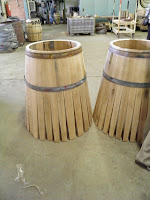
Wood used in these barrels comes from the finest oak trees harvested from the center of France. Young oak, as one could guess, can be harsh, green, and bitter in flavor. That fact makes old, 160-170 year old plants sought after. At Gamba, not only is each barrel made from the best wood, but staves are made by splitting the wood rather than cutting it (except for large casks where wood must be sewn together). This method is laborious, but makes a higher quality stave, in that it maintains the fiber of the wood. At Gamba, the staves are treated with respect and care, even bending them is done in the least invasive way. Wood can be bent either by fire or water. Fire produces thinning of the staves, so Gamba uses water to maintain the thickness and quality.
After the wood is split, cut, and bent, the barrels are assembled. Saves are put together, sealed with a paste, and held in place by rings. Before we go further, I just want to talk about this paste. On the day we toured, Gamba just happened to be making Kosher barrels for the making of kosher wine. You might be asking yourself what on earth is different in kosher barrel from a non-kosher barrel. The answer is found in the paste. In a regular barrel this paste, which acts as a sealant, is made of ash, flour, and water. However, in Kosher barrels the paste is made of ash, honey, and water. Mauro told us that Gamba is the leading producer of kosher barrels. Who would have thunk?

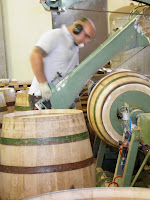
Ok, back to making barrels . . . . Where were we? Split . . cut, bent, and . . . aw yes, held together by rings. To this a hand forged ring is placed around the staves then pressed tightly into place by a giant machine.

What’s next? The part we have all been waiting for, the toasting. Back in a small dark room, lit by the glow of flames and the glimmers of sunlight, is the toasting room. Here, barrels, like loaves of bread, are baked to perfection by coopers and their small pots of fire. Take a look at the video below to see how barrels are made and listen to Mauro explain the most important parts of toasting. This room was my favorite of this tour. It smelled just like bakery, sweet and warm, nutty and delicious. It isn’t any wonder that these barrels flavor the best wines when their aromas are so delectable.

When one looks around this small building, it is amazing to think that the men here produce so many barrels and casks for so many wine makers across Europe. Just about everything here is done by hand, or with limited assistance from a machine. It just goes to show you that even after seven generations, hand crafted details are what make this piece of artwork superior. The blend of technology and tradition here is astounding!

Over the past three years of studying wine at Johnson & Wales, they have stressed that barrels are like spices and a wine must have a strong fruit backbone to be able to be seasoned with these spices. Visiting Gamba really hit home how a barrel acts like a tea or spices that are steeped in a liquid, only instead of being steeped within they double as a vessel that holds the liquid. Along with that clearer understanding, experiencing the aromas given off by these newly toasted barrels cause a sort of sensory discovery. I can better understand what oak can impart now that I know what oak’s aromas really are.

So my friends, go burn some oak, or at least grill some oak or just sniff a tree and see what you can sense. It’s amazing to know the ingredient that makes so many great wines taste nutty, dark, and chocolaty.

Giorno Uno


I’m here! I’m alive! I’m exhausted! I’m too excited to care that I’ve only had two hours of lousy sleep! Dazed and jet lagged, the thirt
y of us pulled our half-dead bodies into the bus,
which was warm and very stuffy. Most of us have been traveling for somewhere betw
een 12-24 hours by now. By my standa
rds, that fact deserves an “Ufdah!”
The long ride shot us thro
ugh the country. We found our way into a small town down roads nearly too small for our buss to fit on them. We found our first stop: Vingne Rigali. We pulled around to the winery, parked next to a white house fit for a princess with palm trees in the yard and rose coated stone walls. . . . . The buildings here are so beautiful. Roses everywhere, poppies freckle the lush green with orange. Everything seems a little too storybook to be real. The houses are either shabby and quaint or ancient and magnificent. Alleys are splashed with

pastel pinks, greens, and yellows. Everyone has shutters, everyone hangs their laundry to dry, and everyone has plants covering at least a third of every surface. Leaves and petals seem to grown right out of the walls. Trees here look like bouquets stuck in the ground so upright and all in perfectly straight rows. I never want to
leave!


At the winery we meet the director, Alberto Lazzario. Shock and awe permeated the group as he showed us his cellar filled with hundreds and hundreds of bott
les containing wine in the midst of second fermentation. In-bottle second fermentation is the process by which the sparkle is put into the highest quality sparkling wines. Historically called,
Methode Champenoise or Method Classico, this is the same process used in Champagne, France.

Check out the clip below and listen

to Alberto explain how sparkling wine is made.
(Coming soon)

As we moved into the second room, Alberto showed us the machines that turn this fermented treasure into a finished sparkling wine. Machine number on
e: bottles are placed neck down and the tip is frozen. This ice cube of yeast is removed and di
scarded. This process of removing the yeast is called disgorgement. At the next machine, sues reserve, reserved wine, is added to the

bottle to fill in the empty space and in some cases sweeten the sparkling wine.
After learning the complete process of making these wines, the only logical next thing to do now was to taste them. Alberto handed us a glass of sparkling Gavi called Principessa Perlante . . . then a still wine Principessa Gavia . . .. Then we tried what became my fa
vorite of the day Rosa Regale.
This red Sparkling- made from an aromatic grape. Aromatic grapes, unlike other grapes, show the same strong characteristics in both the aroma and flavor. Moscato is an aromatic
grape. It is a dessert red and as much as it smells like a bouquet of roses and a bowl of macerated strawberries it tastes like the lush petals sweet berries straight from the garden. The sweetness in this wine is not overwhelming and cut by strong acidity and zippy bubbles. I recommend this wine to everyone that likes . . . . um well to taste! Everyone in the group loved this wine. AND Good news: it’s available in the states. Although it is a red wine, the taste and aroma make it as approachable as a white
or blush to those who stay clear of reds.

After the tasting, we followed our leader into a tall white room filled with shining silver tanks. We

stood surrounded by fermenting juice. Each tank here holds enough juice for hundreds of thousands of bottles of wine. Just before stepping into the holding area, Alberto lets us sneak a sniff of the fermenting wine. I was astounded! As he turned the knob, a
hiss of potent aromas escaped from what will become Rosa Rigale I bent down to the spigot to breathe in the loveliness. To my surprise, it smelled sweet, and not very yeasty at all. In fact, it reminded me of banana laffy taffy! What artistry is must take t
o guide this extravagant and wild juice into the lovely creature I had just en
countered in my glass. As we passed from room to room my amazement only grew. We taste pure muscato grape juice as well as among other juices at the beginning of fermentation. These grape juices were no juicy juice. They didn’t even taste like grapes!
As our tour wound down we walked through the bottling area, saw mushroom corks and how they are inserted, we saw the pasteurizer, walked between stacked pallets of wine, and

ended up in the barrel room. Dark and dramatic this room hits to the myste
riously wonderful liquid that hides behind the wooden veils. This next part was a truly Filled with Alborosa and dolcetta. Alborosa is a cross- not a hybrid of nebiolo an
d barbera. Only four wineries in the world make it, and we taste it from the barrel.
Wow! First wine it Italy, first winery, first glimpse into this world that is not longer just a boot on the map, I
just can’t believe it!
After the wine tour we ate what was called a “light lunch” a disguise fo
r a large lunch of so-called lighter fare.